
Researchers build new antibody to target cancer cells
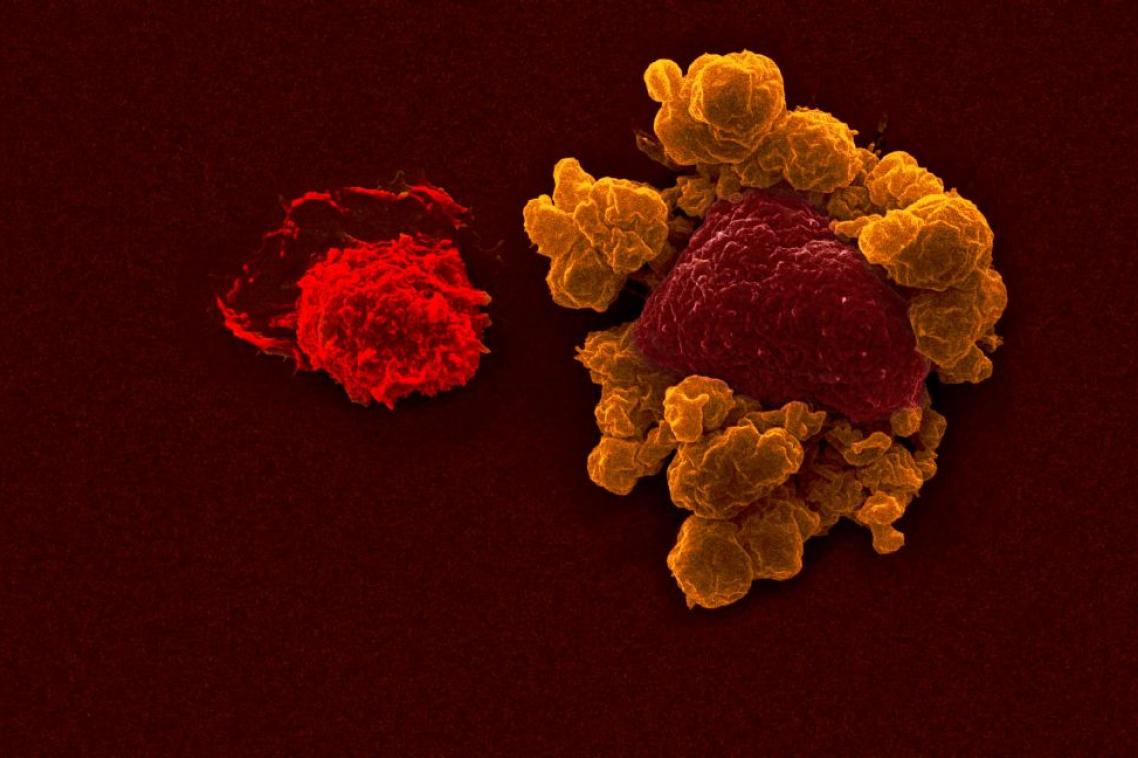
An electron microscope image showing a tumour cell breaking up and dying (dark red and orange) after being attacked by a natural killer cell on left (red).
(Photo credit: The University of Queensland. )
Key points
- Researchers engineered 'super natural killer' cells to help destroy hard-to-treat tumours such as triple-negative breast cancer.
- The new antibody helps the immune system kill cancer more effectively while aiming to spare healthy tissue.
- This approach could improve survival and quality of life by shrinking tumours with fewer side effects than some current therapies.
A cancer-targeting antibody that helps the body’s immune cells spot and destroy hard-to-treat tumours such as triple-negative breast cancer has been developed by researchers.
The University of Queensland’s Associate Professor Fernando Guimaraes said the antibody recognises a unique part of the ROR1 protein, which is found on many aggressive cancers but rarely on healthy cells.
“The antibody precisely targets cancer cells, helping the immune system kill cancer more effectively while aiming to spare healthy tissue,’’ Dr Guimaraes said.
“This could translate to treatments that are both more effective and gentler.’’
Dr Guimaraes, whose group at the Frazer Institute led the research, said the new antibody activated natural killer (NK) cells – a type of immune cell that destroys tumours.
The researchers found the antibody worked best when combined with treatment that blocked a cancer immuno-suppressing signal – Transforming Growth Factor-beta or TGF-β.
“We engineered ‘super NK cells’ to boost cancer control,’’ Dr Guimaraes said.
“By giving NK cells a genetic upgrade and making them resistant to TGF-β, we created enhanced immune cells that were able to find and destroy ROR1-positive tumours more efficiently in both laboratory and animal models.
“Triple negative breast cancer is an aggressive and difficult-to-treat cancer, with limited effective therapeutic options currently available.
“Our results open the door to new immunotherapy options, including an upgraded version of NK cells that are better at finding and killing cancer.’’
Dr Guimaraes said the results provide a foundation for future research into clinical applications.
“If successful in people, this approach could improve survival and quality of life by shrinking tumours with fewer side effects than some current therapies,’’ he said.
“In practical terms this could lead to clinical trials and, longer term, new treatment choices for patients who currently have few.’’
The research is published in Molecular Therapy.
Collaboration and acknowledgements
UQ’s Frazer Institute is based at the Translational Research Institute.
The project included contributions from UQ Centre for Clinical Research, Queensland Cyber Infrastructure Foundation, the National Biologics Facility, Therapeutic Innovation Australia BASE mRNA Facility, Pontifical Catholic University of Paraná, Mater Research Institute-UQ, Peter MacCallum Cancer Centre, Olivia Newton-John Cancer Research Institute, and University of New England.
This project would not have been possible without the philanthropic support of Cooper Rice-Brading Foundation, The Tie Dye Project, The Kids Cancer Project, Bricks & Smiles, Tour de Cure, Richie’s Rainbow Foundation, National Breast Cancer Foundation, and the PA Research Foundation.
Topics
Related articles

Study exposes burden on carers of children with feeding tubes
