
Menu change for corals in warming reefs
Warming coral reefs are losing their capacity to feed themselves from sunlight, making nutritious deep ocean water critical for their survival, according to a University of Queensland study.
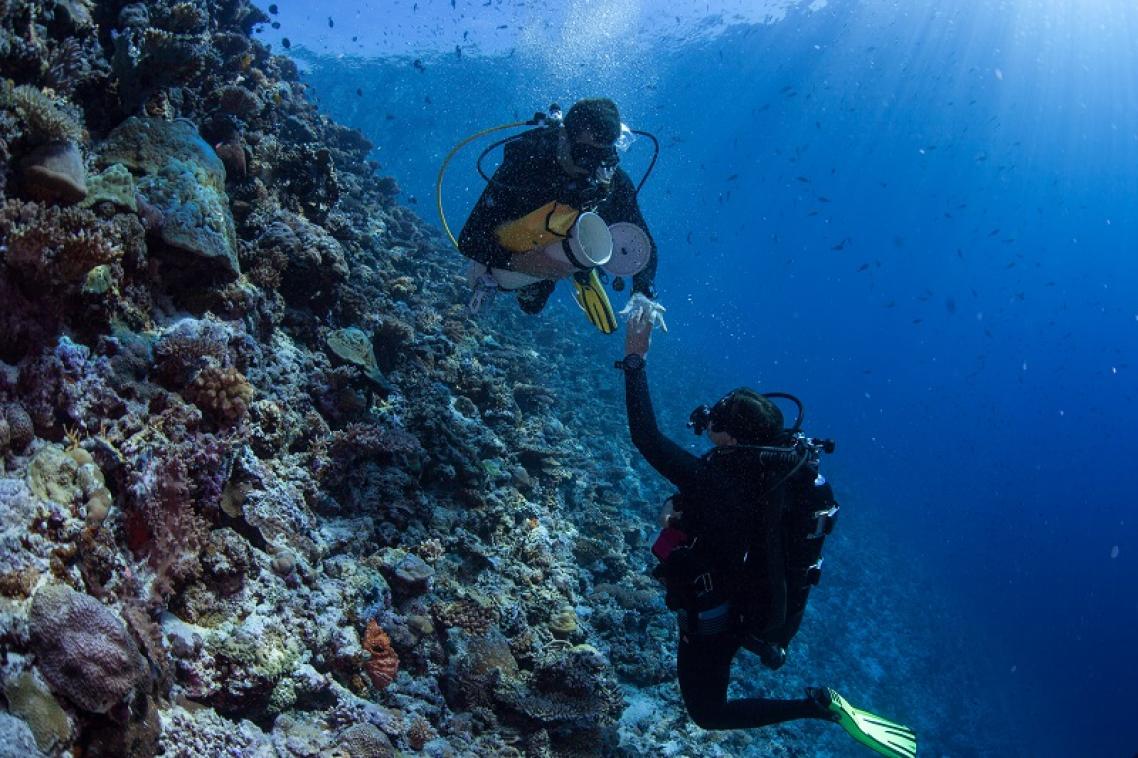
UQ PhD candidate Veronica Radice analysed coral samples from the Maldives to find out what corals were feeding on in a remote atoll system.
“Corals depend on different sources of nutrition including sunlight and nutrients in the water,” she said.
“What many people don’t realise is that corals have algae living in their tissue, which allows them to photosynthesise sunlight, giving the coral some plant-like properties.
“However, ocean warming due to climate change is causing these corals to be stressed, which makes them lose this nutritional source from their symbiotic algae.
“So we thought it was important to see what other food sources corals were relying on.”
Ms Radice and her colleagues collected fragments of three species of coral from reefs at 10 metres and 30 metres depths in the Maldives.
“We separated the tissue of the symbiotic algae from its coral host tissue, and samples were then prepared for isotopic analysis,” she said.
“This allowed us to break apart a coral’s diet and nutrients, looking at the ratios of different isotopes – for example, carbon or nitrogen – giving us clues to where these nutrients might come from.”
The data revealed how important deep-water nitrogen was to coral nutrition in this remote archipelago of the Maldives.
“We realised that certain ocean movements are increasingly important in bringing nutrients to shallow water coral reefs.
“The seasonally reversing monsoon winds in the Maldives are a great example of this, generating deep-water ‘upwelling’, which brings nutrient-rich waters to the surface.”
The researcher and her colleagues are now hoping to look at stressed coral phenomena, applying the same isotope analysis.
“We’re starting to use this technique to analyse coral after a mass bleaching event,” she said.
“It’s sad to see these beautiful organisms struggling in a changing world, but I’m hoping this research can help us learn how to protect our reefs for generations to come.”
The research is published in Functional Ecology (DOI: 10.1111/1365-2435.13314).
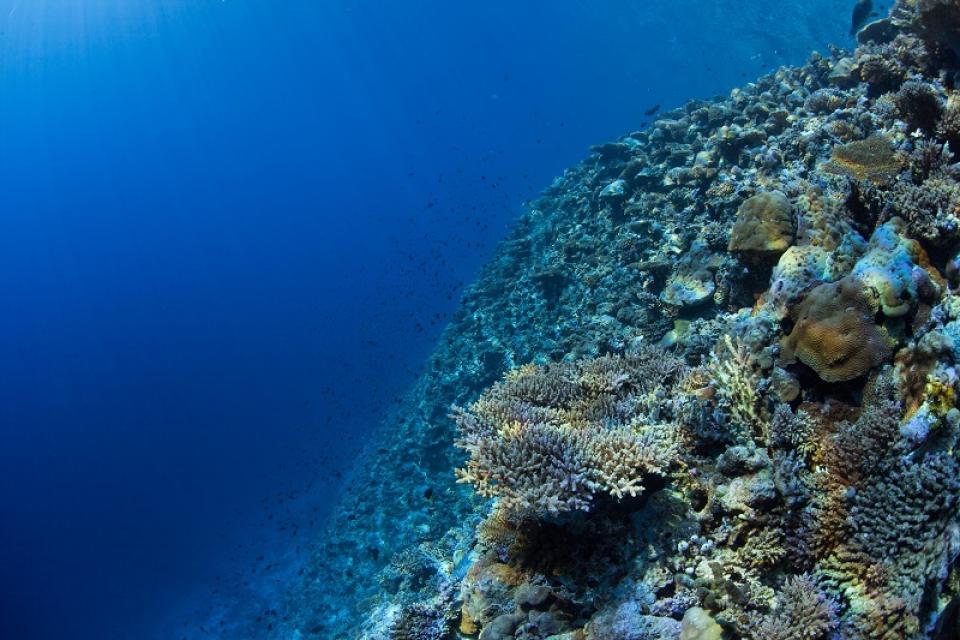
Image above: A typical coral reef slope in the Maldives, Indian Ocean. Credit: Christophe Bailhache/Underwater Earth
Media: Veronica Radice, v.radice@uq.edu.au, +61 435 905 795; Dominic Jarvis, dominic.jarvis@uq.edu.au, +61 413 334 924.
Related articles

The Great Barrier Reef has a microbiome too
