Skip to menu Skip to content Skip to footer
News

Foundation to help preserve Moreton Bay
29 August 2019
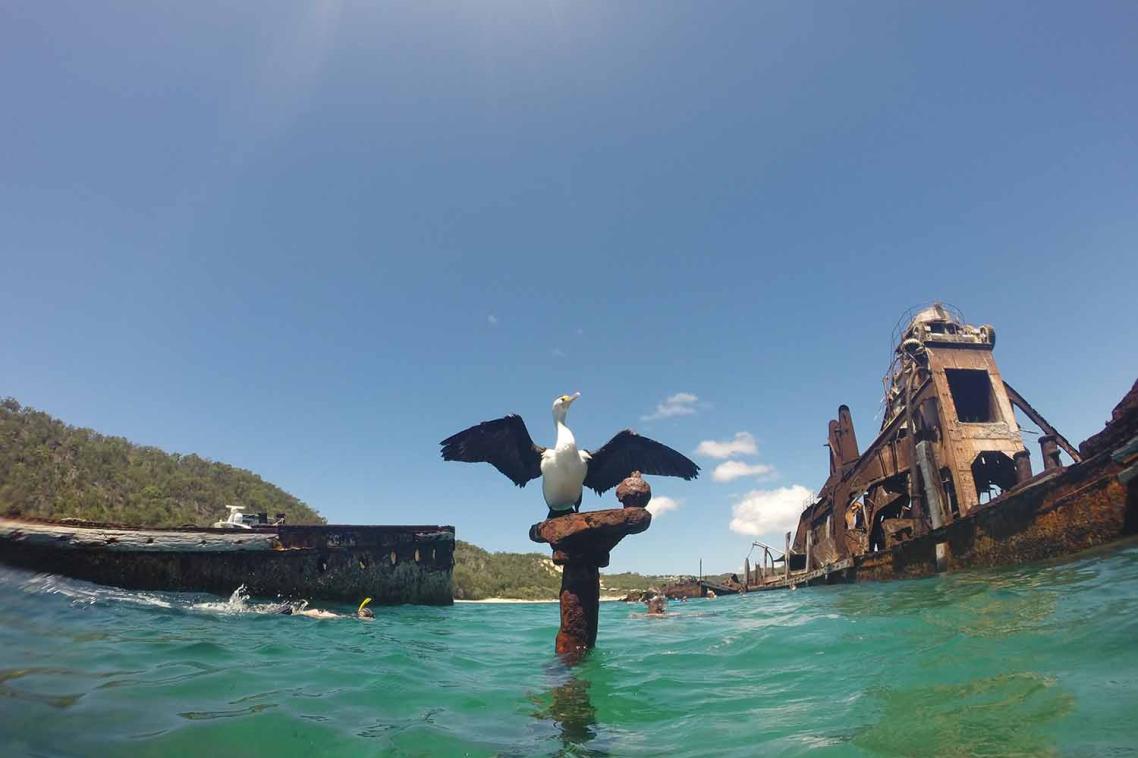
Industrial and residential expansion is causing a significant loss of natural habitats for many species of animals, birds, and marine life

The University of Queensland is helping to establish a foundation aimed at preserving Moreton Bay’s unique biodiversity, cultural heritage and aesthetic beauty.

The Moreton Bay Foundation will be launched tomorrow by the Honourable Paul de Jersey AC, Governor of Queensland.

The Foundation aims to provide quality evidence-based knowledge, scientific consultation, and to connect researchers, community members and government representatives.

Associate Professor Ian Tibbetts from UQ’s School of Biological Sciences said the Moreton Bay catchment – stretching from Caloundra to the Gold Coast – was at a crucial intersection of commerce and ecology.

“Moreton Bay needs a mechanism for bringing together expertise and knowledge across institutions and agencies now more than ever,” Dr Tibbetts said.

“The Foundation does just that, being developed from a forum held at UQ in 2016.

“UQ had been working closely with the Goodman Foundation to hold a meeting of Moreton Bay-oriented researchers, non-government organisations and managers, repeating a similar meeting held 20 years before.

“It quickly became obvious to attendees that we mustn’t wait another 20 years for the next meeting, given pressures from the rapidly increasing human population, climate change and sea-level rise affecting the region.”

Foundation chairman Rob Siganto said the organisation would be focused on building collaborative partnerships.

“We’ll be linking together researchers, community members, traditional custodians and government representatives,” Mr Siganto said.

“Collectively, we can develop a master plan to actively preserve this delicate ecosystem and international treasure as a pristine natural resource for generations to come.

“This is critically important – Moreton Bay and its catchment areas are some of Queensland's most important coastal resources and underpin tourism, recreational and professional fisheries, and island and coastal development.”
Decorative
The Moreton Bay Foundation will aim to address an increasing number of natural and man-made hazards threatening the health of the Bay area.

“We’re seeing an elevated amount of mud and sediment flowing into the Bay, from the Brisbane River system largely due to seasonal floods and storms, which decreases the water quality,” Mr Siganto said.

“Industrial and residential expansion in South East Queensland is causing a significant loss of natural habitats for the many species of animals, birds, and marine life that call Moreton Bay home.

“The Moreton Bay Foundation is in a unique position to connect local knowledge with evidence-based scientific research to assist community groups, government, universities and businesses make informed decisions that will shape sustainable solutions for the Bay and its communities.”

The Foundation’s initial Community Consultation will be held tomorrow at Brisbane City Hall; free tickets are available on The Moreton Bay Foundation website.

The Foundation’s founding partners include UQ, Queensland University of Technology, Griffith University and the Quandamooka Yoolooburrabee Aboriginal Corporation.

Media: Ian Tibbetts, i.tibbetts@uq.edu.au, +61 431 086 297; Rob Siganto, rob@southpacificcruises.com.au, +61 417 275 799; Dominic Jarvis, dominic.jarvis@uq.edu.au, +61 413 334 924.

Related articles

Three researchers wearing blue protective lab gowns stand among rows of potted chickpea plants inside a controlled-environment plant research facility.

Turning up the heat on chickpea yield

A University of Queensland study has outlined a practical pathway for accelerating the development of heat adapted chickpeas using data from new ‘omic’ technologies. PhD candidate Callum Jamie said the suite of technologies offered tremendous opportunities to understand how a complex trait like heat tolerance works. “The narrow genetic diversity in the elite chickpea gene pool has limited conventional breeding’s effectiveness for stress tolerance,” Mr Jamie said. “These technologies have improved our capacity to dissect trait architecture and phenotype secondary traits but their use in chickpeas has been limited.” The technologies include genomics, epigenomics, transcriptomics, proteomics, metabolomics, phenomics and enviromics, and help provide a comprehensive picture of biological systems. Epigenomics helps understand what controls gene activity; transcriptomics considers gene expression; proteomics protein production; metabolomics looks at biochemical processes; phenomics observes traits; and enviromics considers environmental factors influencing outcomes. Mr Jamie said previous studies had focused on just 1 to 2 -omic datasets, a small number of genotypes, and single tissues. This has meant it was hard to infer what results meant for trait architecture and mechanisms and the ability to extrapolate the information to breeding populations was limited. There have also been challenges around cost, scalability and integrating very different types of data to make the technologies useful. To overcome the hurdles, Mr Jamie’s research at the Queensland Alliance for Agriculture and Food Innovation has resulted in a proposed staged approach. It would start with genomic prediction and phenotyping, before adding -omic layers as costs fall and unknowns were resolved. “These technologies are novel and we still don’t know which information provides added value and how best to integrate all of this data to achieve an outcome,” Mr Jamie said. His PhD is supported by the Grains Research and Development Corporation (GRDC) and the International Research Training Group (IRTG) Accelerating Crop Genetic Gain and is aligned to a project which aims to fast-track the development of chickpea varieties adapted to high temperatures. Project leader Dr Millicent Smith said heat stress causes severe yield implications through flower and pod loss, reduced pollen viability and impaired grain filling. “Late sown chickpea is particularly in the firing line across most of Australia's crop in southern Queensland and northern New South Wales,” Dr Smith said. “We want to ensure that Australian growers maintain their competitive edge. “New varieties with improved genetics to cope with heat stress are essential for the future. “This work, suggesting a staged approach to utilising the new -omic technologies, is an exciting frontier.” The research was published by Food and Energy Security. Callum Jamie’s PhD is supported by the Grains Research and Development Corporation (GRDC) and the International Research Training Group (IRTG) Accelerating Crop Genetic Gain.
15 October 2026
Close-up photograph of a red-bellied black snake coiled across pale, weathered wood. The snake has glossy black scales on its back and vivid red coloration along its sides and underside. The image highlights the texture of the scales and the contrast between the dark body and the light wood background.
Analysis

Deadly fungi are harming Australia’s wild reptiles. This is how to stop the spread

With spring underway and the weather warming, reptiles are on the move in suburbs, parks and bushland across Australia. Snake catchers and wildlife carers are responding to calls for help, and reptile enthusiasts – known as “herpers” – are heading outdoors in search of their next sighting.
13 October 2026

Media contact

Subscribe to UQ News

Get the latest from our newsroom.