
Commuters see fewer familiar faces post pandemic
(Photo credit: The University of Queensland )
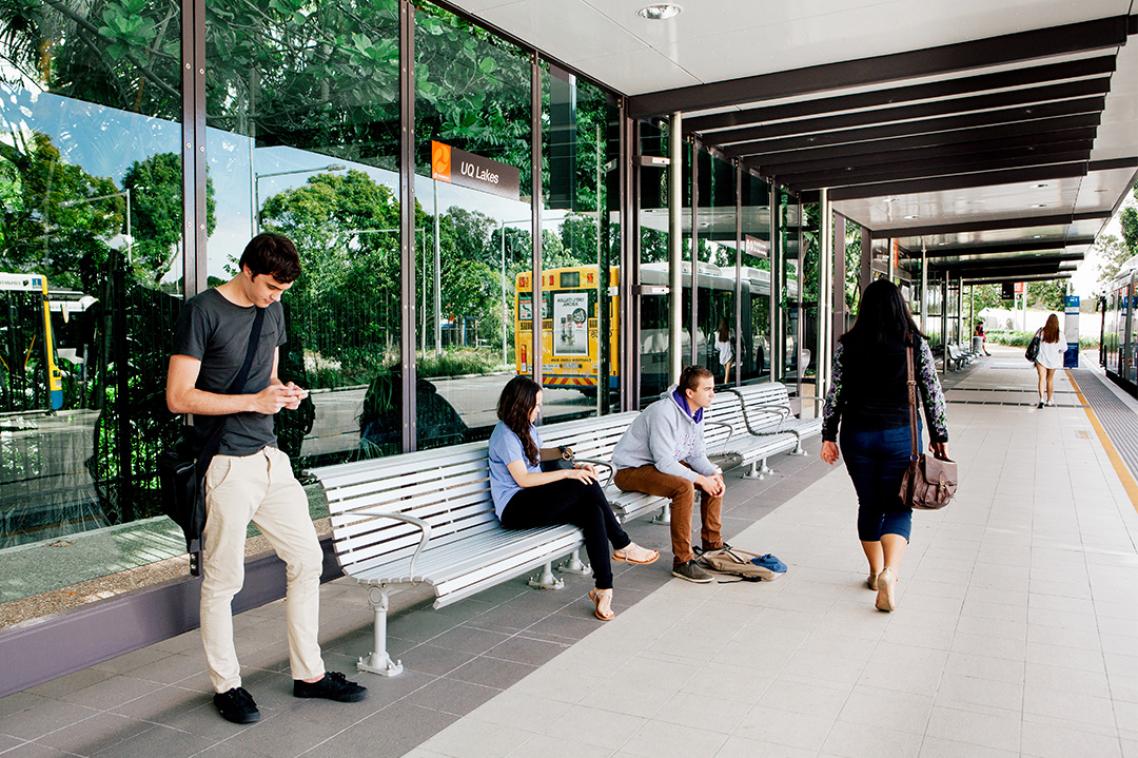
Seeing people we recognise on the train or at the bus stop can enhance feelings of safety and comfort but a University of Queensland study shows fewer people are regularly crossing paths on Brisbane public transport now than before the COVID-19 pandemic.
The finding raises concerns about opportunities for social connection in the city.
Associate Professor Renee Zahnow and Professor Jonathan Corcoran analysed 6 years of GoCard trip data for familiar strangers – commuters who repeatedly passed through a bus stop, ferry terminal or train station inside the same 15-minute window.
“These little encounters with other people in everyday surroundings actually help us feel we belong and make us feel safer – even if we barely or never speak to each other,” Professor Corcoran said.
“Each time a passenger taps on to the TransLink system there’s a data point and we scoured this huge pool of anonymous information for matches that occurred at least twice in 3 months.
“As expected, we saw a sudden drop in commuting during the COVID-19 pandemic.
“While people have returned to public transport in Brisbane – with the help of 50 cent fares – familiar stranger interactions have not recovered.
“The recovery to pre-lockdown levels of familiar stranger interactions has been particularly poor in outer suburban areas compared to inner city ones.”
Dr Zahnow said the research indicated routine activities and social structures have not all returned to their pre-pandemic levels.
“The pandemic accelerated changes that were happening slowly in our communities, things like shopping online, working at home and moving to homeschooling,” Dr Zahnow said.
“The results of the study reflect a decline of the collective 9 to 5 workday and a trend toward greater flexibility in our lives which is associated with fewer individuals routinely moving through the same places at the same times.
“Transit stations are community spaces in which people have a shared connection through a common activity, even if characteristics like age or ethnicity are very different.
“While benign and effortless, incidental interactions actually bind communities together.
“When people recognise others around them, they feel safer and are more likely to step in to help in the case of disaster or emergency.
“If everyday interactions are not happening as much via commuting, we need new strategies to build connections and help stem loneliness, anxiety and feelings of being unsafe.”
The research has been published in Transportation Research Part A: Policy and Practice.
Related articles
UQ scientific excellence reaches the global pipeline in landmark deal
