
Walking exoskeleton trial keeps people with MND moving
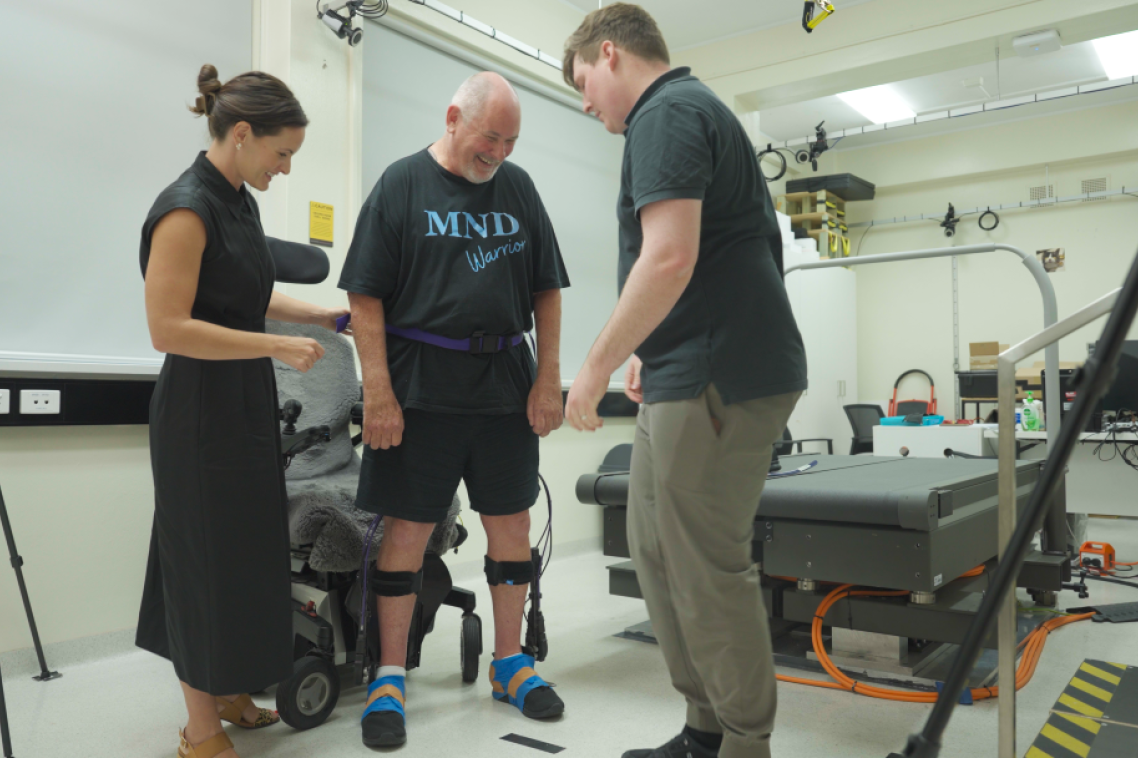
Associate Professor Taylor Dick (left) and Dr James Williamson with trial participant Robert Taylor in UQ's Neuromuscular Biomechanics Laboratory.
(Photo credit: The University of Queensland. )
Researchers at The University of Queensland are using wearable robotic exoskeletons to help people with Motor Neurone Disease (MND) walk further, faster and with more confidence.
The device, designed to enhance movement by providing assistance at the ankle joint, is being trialled as part of the iMOVE-MND project led by Associate Professor Taylor Dick from the School of Biomedical Sciences.
“We are seeing exoskeletons go from fiction to reality; our device consists of a small pack containing the ‘brain’, motors and batteries worn around the waist, with cables that transmit force to the ankles making it easier for a person to walk," Dr Dick said.
"A bit like adding an extra spring in your step.
“It’s lightweight, portable and untethered, so we can move beyond the lab and into the real world.
“We’re targeting the ankle joint based on our biomechanics research showing it plays a critical role in walking performance for people with MND.”
Dr Dick said the device is intended to help people with MND maintain mobility for as long as possible.
“Most robotic exoskeletons are used in rehabilitation to restore function over time,” she said.
“We wanted to use it differently, to help people maintain walking function and independence as the disease progresses.
“The device is the first of its kind in Australia and it’s a world-first to trial it on participants with MND.
“We’re excited to be testing the technology in real world environments, not just in the lab.”

The MND exoskeleton assists users by applying force at the ankle.
(Photo credit: The University of Queensland.)
Dr Dick said the results so far had been impressive, with participants noticing an immediate improvement in mobility.
“We hear things within 5 minutes of wearing the device like: ‘I regained my confidence in walking’.”
Dr James Williamson, a Postdoctoral Research Fellow at the School of Biomedical Sciences, is leading the technical development of the device.
“The exoskeleton uses sensors to detect force through the foot and applies mechanical assistance accordingly,” Dr Williamson said.
“A mini motor for each leg helps with plantarflexion and dorsiflexion, which means moving the leg up or down, and we apply that assistance for each and every step.”
Dr Williamson said feedback from trial participants had been overwhelmingly positive.
“When someone gets the exoskeleton on for the first time, you see their face change,” he said.
The team is working on a second-generation version of the device, with improved sensors and machine learning to personalise assistance.
“We’re trying to make it specific, comfortable and easy to use with the goal of getting it out of the lab and into the hands of the people who need it most,” Dr Williamson said.

Robert Taylor (centre), a Brisbane man living with MND, demonstrates the effectiveness of the exoskeleton, supervised by Associate Professor Taylor Dick and Dr James Williamson.
(Photo credit: The University of Queensland.)
Dr Dick said the next steps included testing the exoskeleton over longer timescales to track how it performs as the disease progresses.
“We want to see how a person’s mobility changes over weeks and months, not just in short lab visits,” she said.
“Our intention with this device is to help people living with MND maintain independence for as long as possible."
"The project is part of a much broader effort at UQ to improve quality of life for people with MND.
“The University is a national and global powerhouse in MND research, and I’m fortunate to collaborate with Associate Professor Shyuan Ngo and Associate Professor Frederik Steyn, who have been leaders in the field for decades."
The UQ Centre for Motor Neurone Disease (MND) Research was launched earlier this year — the first centre to integrate discovery, translational, care and clinical trial research.
Dr Williamson said the goal of the exoskeleton was to increase the number of steps someone can take in a day while minimizing their fatigue.
“If we can help someone stay out of a wheelchair for a week, 2 weeks, a month, then that’s a massive win,” he said.
The iMOVE-MND project is recruiting participants – people living with MND who are interested in taking part are encouraged to contact Associate Professor Taylor Dick at t.dick@uq.edu.au.
This research is currently funded by the ALS Association.
Topics
Related articles

Fast-tracked genetic testing helping sick kids
